

When communities come together to talk about difficult topics—like repatriation and reconciliation—the conversations are layered,emotional, and deeply significant. These discussions aren’t just about policies or procedures; they’re about people, histories, and relationships.
Truth and Reconciliation is not just a national conversation in Canada—it’s a responsibility we all share. As a country shaped by a difficult history of colonialism and the profound harms of the residential school system, we are called to listen, learn, and take meaningful action. Honouring Truth and Reconciliation means acknowledging the truths of Indigenous communities, recognizing the resilience and leadership of First Nations, Inuit, and Métis peoples, and committing ourselves to building relationships rooted in respect, justice, and real change.
It’s ongoing work and it matters now more than ever.
At recent Repatriation Policy Engagement Sessions in British Columbia, participants explored what it means to honour the return of Ancestors and cultural belongings to First Nations. These are not easy conversations. They involve pain, healing, and the complexity of rebuilding trust.
That’s where graphic recording can play a transformative role.
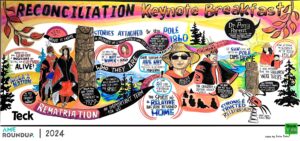
Seeing the Unspoken
In these sessions, Erica Bota worked alongside participants to listen deeply and translate spoken words into visual form. Through illustration, colour, and composition, the drawings helped hold space for the many voices in the room.
The imagery itself tells a story of connection and reciprocity. Flowing lines link concepts like respect, relationship building, and spiritual reconciliation.
Making Complexity Visible
The topic of repatriation is inherently complex—legal, emotional, and spiritual all at once. Graphic recording helps by creating a visual map of that complexity.
On the wall, ideas such as “honouring our ways,” “cultural connection and economic development,” and “not extractive but reciprocal” are woven into a single narrative landscape. This helps participants see how different perspectives connect, overlap, and reinforce one another.
When we can see the whole picture, it becomes easier to find common ground.
Supporting Emotional and Cultural Depth
For many participants, the return of Ancestors and belongings is sacred work—a theme clearly depicted in the image through symbols of fire, water, and the canoe. These visuals do more than decorate the conversation; they hold emotional truths that might be difficult to express in words.
Graphic recording also honours oral traditions. The image reflects how “we are a verbal people,” and how listening and storytelling remain central to First Nations ways of sharing knowledge. By translating those spoken words into imagery, graphic recorders help preserve them in a new, accessible form—one that communities can return to, reflect on, and share.
Building Trust and Understanding
In processes of reconciliation, trust is built through respect and visibility. Seeing your words and ideas appear on the page—drawn live, in real time—can be profoundly validating. It shows that what you shared has been heard and honoured.
At these sessions, phrases like “Listen to what Nations want,” “Respect one another,” and “Everything is connected” remind us that graphic recording is not just about capturing what was said. It’s about visually affirming the relationships and values guiding the work.
A Visual Record for Moving Forward
When the drawings are completed, they become a collective artifact—a piece of visual history that communities and policymakers alike can refer back to. They capture not only the words, but the spirit of the gathering.
As the graphic recording shows, repatriation is about bringing Ancestors home—but it’s also about bringing stories, relationships, and responsibilities home.
And through thoughtful use of imagery, graphic recording helps make that journey visible, memorable, and deeply human.
We could love to have the honour of supporting your community conversation.


